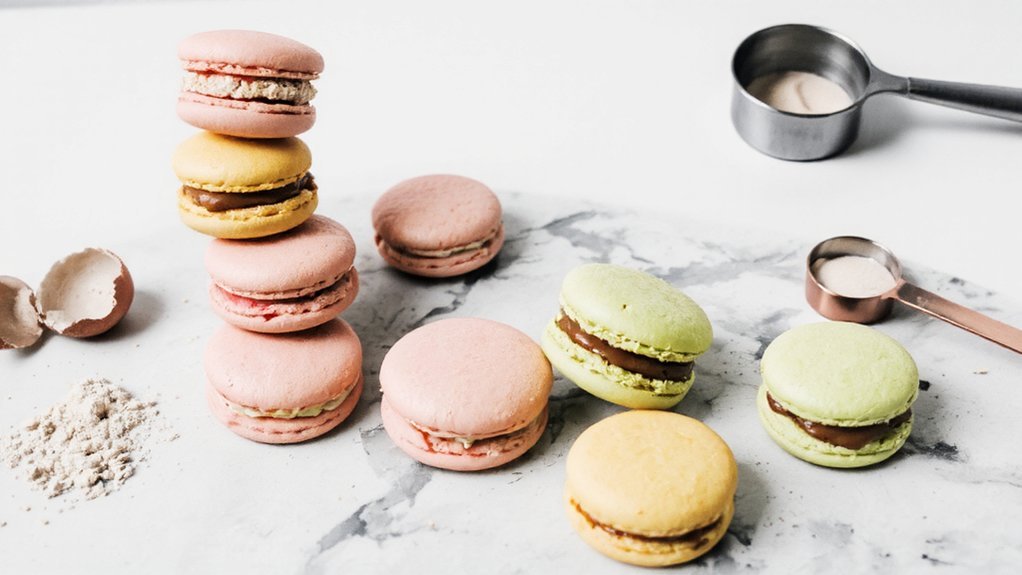

Key Takeaways
- Sift almond flour and powdered sugar twice, then fold into stiff meringue until ribbon-like consistency forms.
- Pipe uniform shells onto parchment, rest 30–60 minutes until skins form to prevent cracking during baking.
- Bake at 300–325°F for 15–18 minutes; use oven thermometer to ensure accurate temperature and prevent hollow shells.
- Cool completely on baking sheets before removing to preserve structural integrity and prevent shell breakage.
- Store in airtight containers at room temperature three days, refrigerate two weeks, or freeze up to three months.
Ingredients You’ll Need
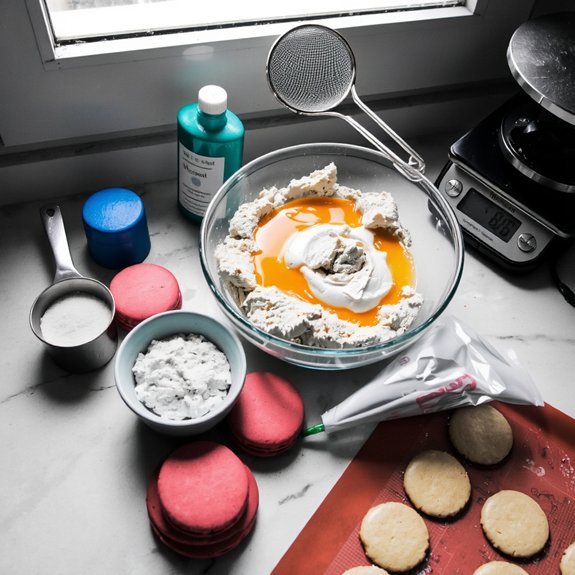
You’ll need almond flour, powdered sugar, egg whites, granulated sugar, and food coloring to create these delicate meringue-based confections. The almond quality directly impacts your final product’s texture and flavor profile. Source blanched, finely ground almond flour to guarantee consistent results.
For sugar types, you’ll combine powdered sugar with granulated sugar in your meringue base. The granulated sugar dissolves during whipping, creating stability and structure. You’ll also need egg whites at room temperature—they whip to stiff peaks more effectively than cold eggs. Select gel-based food coloring over liquid varieties; it won’t compromise your meringue’s consistency.
Additionally, you’ll want vanilla extract or other flavorings to complement your chosen colors. Gather parchment paper, piping bags, and macaronage spatulas. These components work together to produce macarons’ signature smooth shells and ruffled feet.
Equipment and Tools
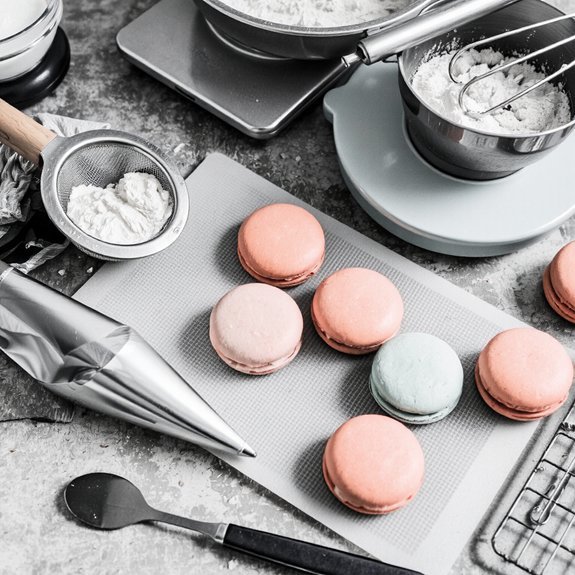
You’ll need a few specialized tools to execute French macarons successfully, starting with essential mixing equipment like a stand mixer, rubber spatula, and sifter for combining your dry ingredients with meringue.
Your piping and baking tools—a pastry bag fitted with a round tip, macaron template, and reliable baking sheets—directly determine the uniformity and structure of your shells.
Investing in quality equipment at this stage prevents common mistakes and guarantees consistent results throughout your baking process.
Essential Mixing Equipment
Precision mixing equipment forms the foundation of successful macaron production, as proper technique and tool selection directly impact meringue structure and final texture. You’ll need a stand mixer with multiple speed settings for accurate speed calibration—this guarantees consistent whipping without overworking your egg whites.
Select a pristine stainless steel or glass bowl; bowl coatings matter substantially since even trace grease prevents proper meringue formation. Avoid plastic bowls entirely, as they retain oil residue that compromises aeration.
You should also invest in a reliable whisk attachment and flat beater. Invest in a digital scale for exact measurements—grams, not cups. These tools give you complete control over your macaron’s destiny, eliminating guesswork and delivering professional results every time.
Piping and Baking Tools
Macaron success hinges on controlled piping and precise heat management, making specialized equipment non-negotiable.
You’ll need a silicone mat or macaron template to maintain consistent shell sizes—artisan craftsmanship demands uniformity.
Invest in a quality pastry bag paired with a round piping tip for clean, even shells.
You’ll also require a reliable oven thermometer since standard oven gauges often misread temperatures.
An oven with superior heat distribution prevents cracked tops and hollow centers.
Consider sustainable sourcing when selecting your equipment; durable, reusable tools reduce waste while supporting ethical manufacturing.
A stand mixer handles meringue incorporation efficiently, ensuring proper macaronage—the critical folding technique that determines texture.
You’ll appreciate how these specialized tools streamline your process, transforming macaron-making from frustrating guesswork into reproducible, precise execution.
Step-by-Step Instructions
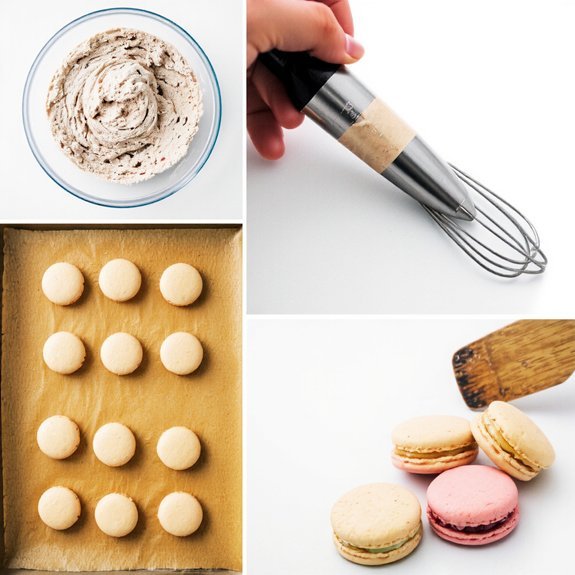
Before you begin, be sure to sift your almond flour and powdered sugar together at least twice to eliminate lumps and incorporate air into the dry mixture.
Master these process milestones through deliberate technique sequencing:
- Fold your meringue into dry ingredients using a spatula, achieving a ribbon-like consistency that flows freely
- Pipe uniform shells onto parchment, maintaining consistent pressure and diameter for even baking
- Rest your piped macarons for 30-60 minutes until they develop a skin, preventing cracking during heat exposure
- Bake at precise temperature (300-325°F) for 15-18 minutes, creating hollow feet and set shells
- Cool completely before removing from parchment to preserve structural integrity
Your success depends on respecting each stage.
Don’t rush the resting period or compromise your ingredient ratios.
Execute these steps with discipline, and you’ll achieve professional-quality macarons that showcase your culinary independence.
Troubleshooting Common Mistakes
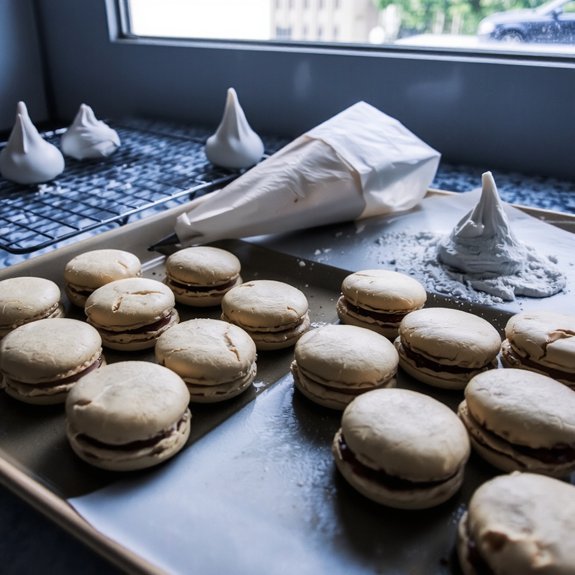
Even when you’ve mastered the technique sequence, macarons can still fail due to subtle errors in execution or ingredient handling.
Cracked tops typically result from overmixing the batter, which deflates essential air pockets, or from insufficient resting time before baking.
You’ll prevent this by folding gently until the batter flows like lava.
Hollow shells indicate underwhipped egg whites or excess moisture in your almond flour.
Confirm your whites reach stiff peaks and sift your dry ingredients thoroughly to eliminate lumps.
Temperature control matters substantially—your oven must maintain consistent heat, so you’ll benefit from using an oven thermometer.
You can also eliminate hollows by increasing baking time slightly at lower temperatures.
Finally, you’ll achieve better results by resting piped shells for 30-45 minutes, allowing skin formation that stabilizes structure during baking.
Flavor Variations and Fillings
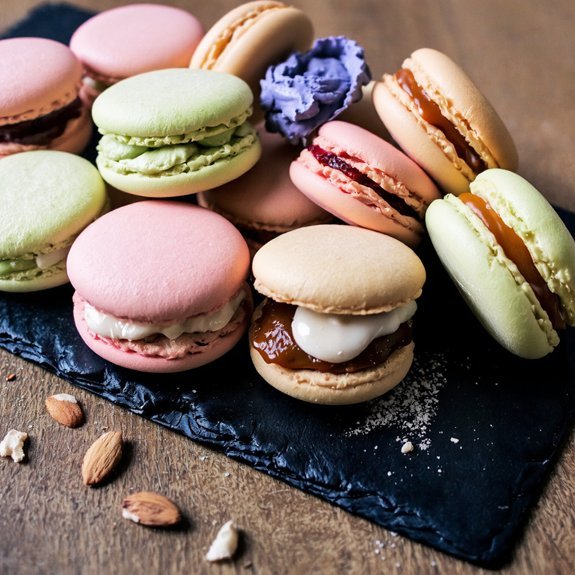
Customizing your macarons’ flavor profile begins with infusing the almond flour or adjusting your meringue base.
You’ll discover endless possibilities by incorporating extracts, food-grade oils, and finely ground spices directly into your dry ingredients.
Regional inspirations guide authentic creations:
- Pistachio and rose water reflect Middle Eastern traditions
- Lavender and honey capture Provence’s essence
- Earl Grey tea infusions honor British sophistication
- Matcha and yuzu embrace Japanese influences
- Dark chocolate and chestnut celebrate French heritage
Your pairing suggestions should complement filling choices strategically.
Lemon macarons pair brilliantly with mascarpone cream, while coffee shells demand dark chocolate ganache. Fruit-forward variations work excellently with buttercream or curd fillings.
You’re free to experiment boldly—balance intensity levels between shells and fillings, ensuring neither overwhelms the other. This approach guarantees sophisticated, memorable macarons.
Storage and Serving Tips
How long can you keep your macarons fresh?
You’ll achieve ideal shelf life by storing them in an airtight container at room temperature for up to three days.
For extended preservation, refrigerate them for two weeks or freeze for three months.
Let frozen macarons acclimate to room temperature before serving—about thirty minutes—to restore their delicate texture.
For presentation plating, arrange your macarons on neutral surfaces that complement their vibrant colors.
Stagger heights using small pedestals or tiered stands to create visual interest.
Pair them with complementary elements: fresh berries, edible flowers, or minimalist ceramic dishes.
Serve them at room temperature to fully appreciate the ganache filling’s complexity and the shell’s signature crisp exterior with yielding interior.
This approach respects both the craft and your guests’ palates.
Frequently Asked Questions
Can I Make Macarons Without a Kitchen Scale or Food Processor?
Yes, you can craft macarons without conventional equipment.
For measuring alternatives, you’ll use volume-based measurements with standard spoons and cups, though precision suffers slightly.
Hand mixing requires vigorous folding techniques to achieve the proper macaronage consistency—incorporate your almond flour and powdered sugar gradually while deflating the meringue methodically. This labor-intensive approach demands patience and technical skill, but you’ll gain complete control over your batter’s final texture and consistency.
Why Are French Macarons More Expensive Than Other Cookies at Bakeries?
You’ll find French macarons command premium pricing because they demand premium ingredients—almond flour, quality chocolate, pure vanilla—and skilled labor.
Bakers invest hours perfecting meringue consistency, piping technique, and aging processes that lesser cookies don’t require.
You’re not just buying a cookie; you’re paying for mastery.
Each macaron represents precise execution and ingredient integrity that justifies your investment in authentic French confectionery.
How Long Do Macarons Typically Last Before They Go Stale?
You’ll find your macarons stay fresh for three to five days when you store them properly in airtight containers.
Their shelf life depends heavily on humidity effects—excessive moisture causes them to soften and lose their signature crisp exterior.
You’re best served refrigerating them to extend longevity up to two weeks.
The almond flour’s oil content and meringue-based structure demand controlled conditions.
Freezing works too, preserving your delicate confections for months without compromising that delicate shell.
What Is the Difference Between French and Italian Meringue Macarons?
You’ll find the texture comparison between French and Italian meringue macarons hinges on moisture content and stability.
French meringue techniques use raw egg whites whipped with powdered sugar, yielding delicate, slightly chewy shells.
Italian meringue methods involve hot sugar syrup streamed into whipped whites, creating denser, more stable structures with glossier shells.
You’ll achieve superior foot formation and shelf stability using Italian techniques, though French methods offer you quicker preparation and authentic traditional results.
Can Macarons Be Frozen, and How Does Freezing Affect Their Texture?
You can freeze macarons up to three months without compromising quality. Proper storage prevents ice crystal formation that’d damage their delicate shells.
You’ll want to thaw them gradually in your refrigerator overnight—this thaw technique maintains structural integrity and prevents condensation from creating a soggy texture. Store unfilled shells separately from filled macarons, as fillings absorb moisture differently during freezing cycles, affecting your final product’s snap and chew.



Leave a Comment